
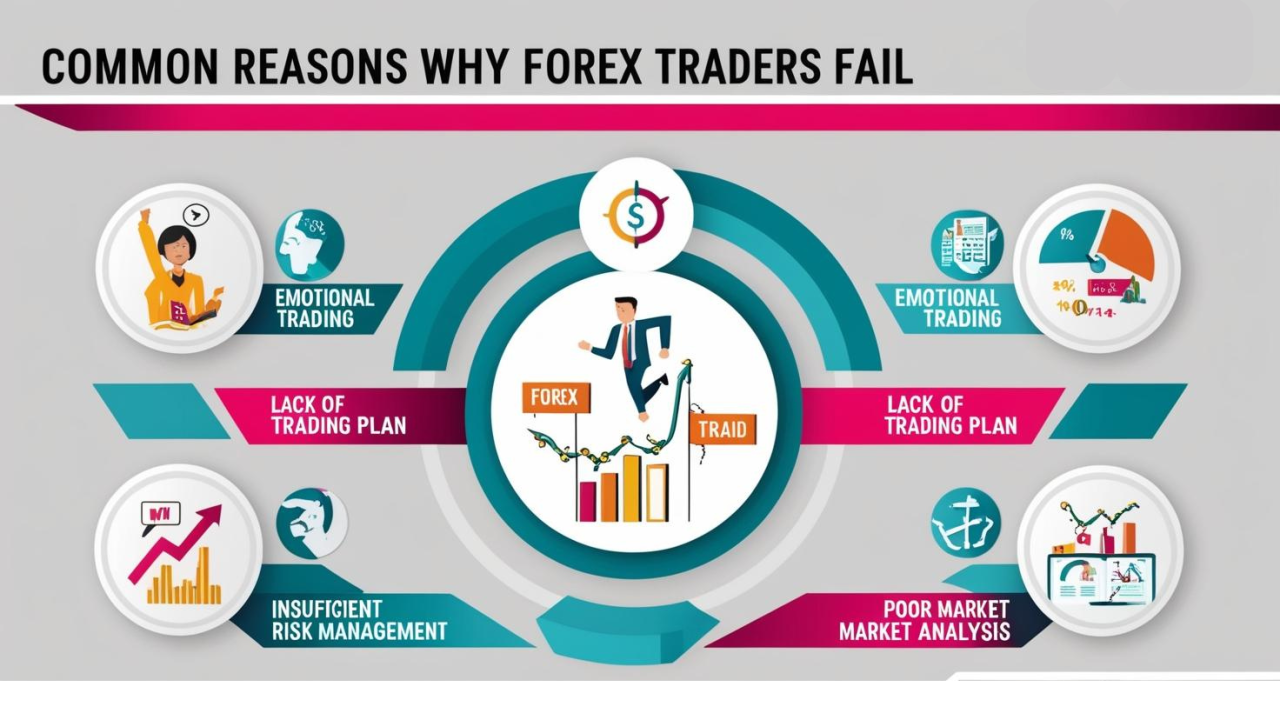
8 Key Reasons Forex Traders Incur Losses
Despite the accessibility of the Forex market, a significant percentage of retail traders consistently incur losses. This phenomenon is not arbitrary but rather a direct consequence of identifiable technical and behavioral missteps. Analyzing these factors with precision is crucial for understanding the high attrition rate observed among new participants.
Inadequate Risk Management and Capital Allocation
A primary driver of retail Forex losses stems from deficient risk management protocols and improper capital allocation. Many brokers offer extremely high leverage ratios, often ranging from 1:200 to 1:500, which dramatically amplifies both potential gains and losses. For instance, a trader utilizing 1:500 leverage on a $1,000 account can control a position worth $500,000. A mere 0.2% adverse price movement on this position (equivalent to 10 pips on a standard lot) results in a $100 loss, representing 10% of the account capital. This contrasts sharply with professional trading firms, which typically employ leverage between 1:10 and 1:50, adhering to more conservative position sizing. Adherence to a strict 1-2% risk rule per trade is paramount; risking more than 2% on a single trade on a $10,000 account means a maximum potential loss of $200. Deviations from this rule, such as risking 5-10% or more, accelerate capital depletion, rendering long-term profitability unsustainable, irrespective of strategy win rates.
Lack of a Robust Trading Strategy and Discipline
A substantial proportion of retail traders operate without a clearly defined, backtested, and consistently applied trading strategy. This often manifests as speculative entries based on intuition, unsubstantiated signals, or fleeting market chatter, rather than a systematic methodology. A robust strategy necessitates precise entry and exit criteria, including predefined stop-loss orders for risk control and take-profit targets. Industry data frequently indicates that approximately 70-85% of retail Forex accounts register losses over a 12-month period, a figure often linked to this strategic void. Traders frequently oscillate between different methodologies without allowing any one to demonstrate its efficacy, leading to inconsistent results and a fragmented understanding of their performance. The trade-off between flexible, discretionary trading and a rigid, mechanical approach often favors the latter for consistency, particularly for new traders who lack extensive market experience to execute discretionary decisions effectively.

Emotional and Psychological Biases
The highly liquid and volatile nature of the Forex market often amplifies psychological biases, leading to irrational decision-making. Common pitfalls include the fear of missing out (FOMO), where traders enter late into trending markets, often at unfavorable prices, resulting in immediate drawdowns. Revenge trading, attempting to recover losses by immediately placing larger or more speculative trades, frequently converts minor setbacks into significant account damage. Overconfidence following a successful trade can lead to increased position sizing or abandonment of risk parameters, turning a positive streak into a substantial loss. Confirmation bias, the tendency to seek information that confirms existing beliefs while ignoring contradictory evidence, can distort market analysis and lead to poor trade selection. These emotional responses directly undermine the disciplined execution of a well-defined strategy, with a single emotionally driven trade capable of negating weeks or even months of carefully managed gains.
Insufficient Market Understanding and Education
Many participants enter the Forex market with an incomplete understanding of its underlying drivers and microstructure. A superficial grasp of technical analysis, such as the misinterpretation of candlestick patterns or the over-reliance on single lagging indicators, often leads to flawed trade decisions. Critically, a failure to comprehend macroeconomic fundamentals – including interest rate differentials, inflation reports (e.g., CPI), employment figures (e.g., NFP), and central bank policy statements – leaves traders vulnerable to high-impact news events. For instance, an unexpected 50 basis point interest rate hike by a major central bank can trigger a 200-300 pip movement in associated currency pairs within minutes, liquidating undercapitalized or unhedged positions. Furthermore, a lack of understanding regarding trading costs (spreads, commissions, swap rates), slippage during volatile periods, and broker execution policies can erode profitability, particularly for high-frequency or scalping strategies. Amateur traders often prioritize readily available indicators over a comprehensive understanding of market dynamics and intermarket analysis.
Key Contributing Factors to Retail Forex Losses
- Utilizing excessive leverage, often exceeding 1:50, without commensurate capital.
- Absence of predefined and adhered-to stop-loss orders for every trade.
- Inconsistent application of a proven trading strategy across varying market conditions.
- Chasing volatile market movements based on social media or unsubstantiated tips.
- Ignoring high-impact macroeconomic news releases and their potential market disruption.
- Lack of systematic trade journaling and post-trade performance analysis.
- Underestimation of transaction costs, including wider spreads during illiquid periods.
Common Mistakes to Avoid
- Initiating trades without a clearly defined, backtested, and validated trading plan.
- Risking more than 2% of total trading capital on any single position.
- Moving stop-loss orders further away from the entry price after a trade moves unfavorably.
- Entering positions based solely on fleeting news headlines or unverified market rumors.
- Failing to adequately backtest and forward-test a trading strategy in a demo environment before live deployment.
- Trading during major economic news releases without a specific strategy designed for such volatility.
- Over-trading (excessive trade frequency) due to boredom or the pursuit of constant action.
FAQ
What is the typical failure rate in retail Forex trading?
Various regulatory bodies and broker disclosures consistently indicate that 70-90% of retail Forex traders incur losses over a 12-month period. For example, ESMA-mandated disclosures in Europe frequently report loss percentages in the 74-89% range among their client base, highlighting the significant challenges involved.
How does leverage contribute to losses in Forex?
Leverage amplifies market exposure beyond actual account capital. While it can enhance profits, it equally magnifies losses. A 1:500 leveraged position on a $1,000 account means a 0.2% adverse price movement (e.g., 10 pips on a standard lot) results in a 10% account drawdown, triggering margin calls and rapid account liquidation if not managed with stringent stop-loss orders.
Is technical analysis sufficient for consistent Forex profitability?
No. While technical analysis provides valuable insights for identifying entry and exit points, it is merely one component of a holistic trading framework. Consistent profitability requires integrating robust risk management, a disciplined trading psychology, and a foundational understanding of macroeconomic drivers. Over-reliance on technical indicators without these complementary elements often leads to suboptimal outcomes and sustained losses.